By Carlos Bardney | Published September 17, 2026 | Updated September 17, 2026
TL;DR
If your air filter has no size printed on it or was trimmed to fit, measure the slot instead. Record width, height, and depth, then round the old frame up to the next whole inch. A 14.5 to 15 inch frame in a track about 1 inch deep points to a 15x15x1; a 15.75-inch frame points to a 16x16x1.
Every unlabeled filter I have measured followed the same rule: the rack tells the truth, and the old frame might not. So I measure the opening first and the old frame second. I trust a size only when both agree.
Key Takeaways
The opening is the reference. Printed sizes fade or get trimmed away; the rack stays the same.
Nominal sizes are rounded labels. A 16x16x1 commonly measures 15.75 by 15.75 inches.
The 15x15x1 deserves a second look. At least one manufacturer lists it at a full 15.0 by 15.0 by 0.75 inches, so the opening must clear 15 inches both ways.
Two readings beat one. When the rack and the old frame disagree, trust the rack.
Why an Unlabeled or Hand-Cut Furnace Filter Is a Poor Guide
The hand-cut filters I have pulled out usually tell one story: someone forced a larger filter into a smaller opening. Measuring that frame gives you the wrong number twice. The cut is rarely square, and the original was already the wrong size.
InterNACHI notes that gaps around the filter frame often signal the wrong size. The U.S. Department of Energy adds that obstructed airflow lets air slip around a filter and carry dirt onto the evaporator coil.
What Do You Need to Measure an Air Filter Slot?
Grab a tape measure that reads to 1/8 inch and a flashlight. Turn the system off first, as ENERGY STAR's filter-change steps advise.
How Do You Measure for a 15x15x1 Filter?
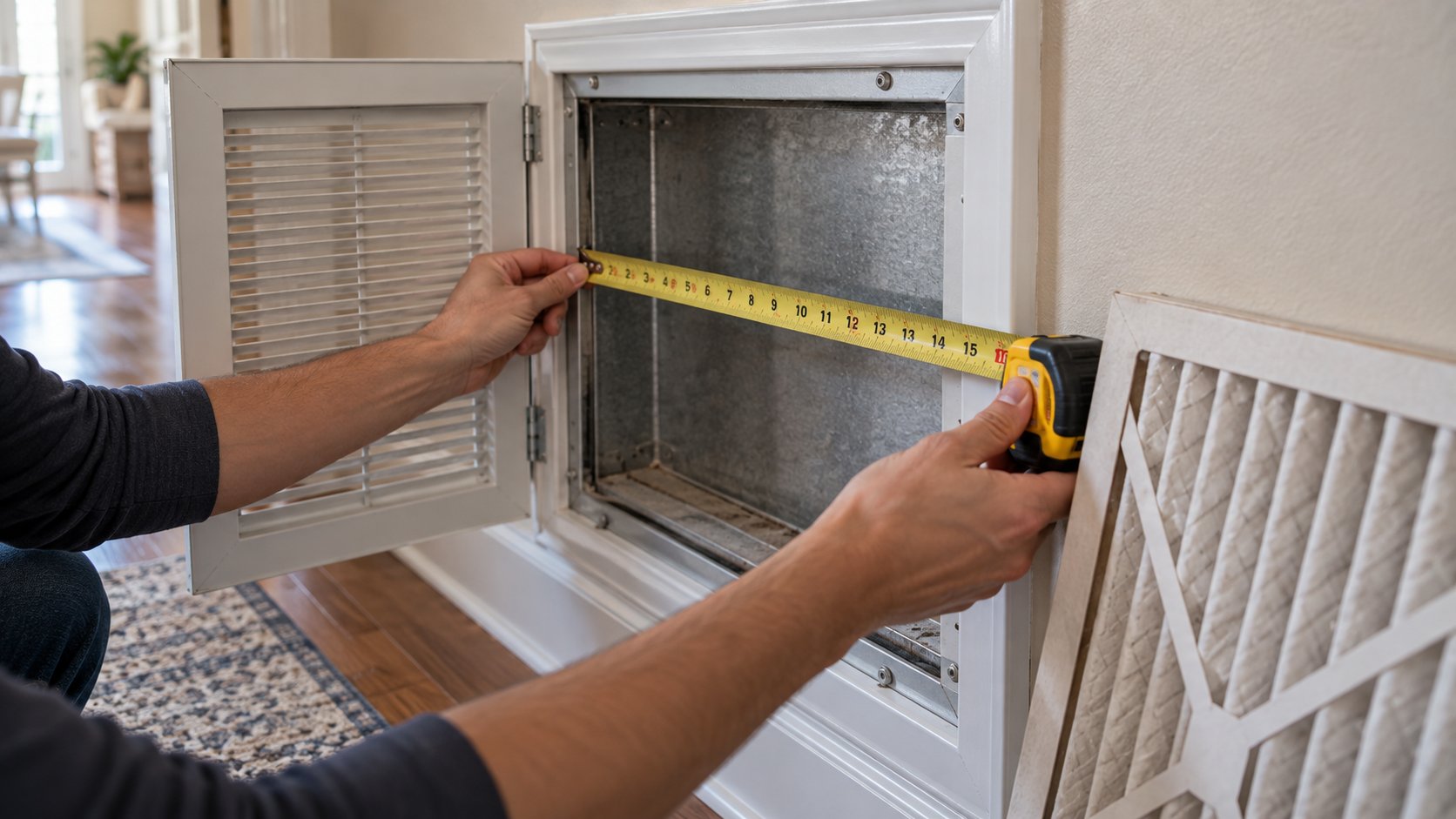
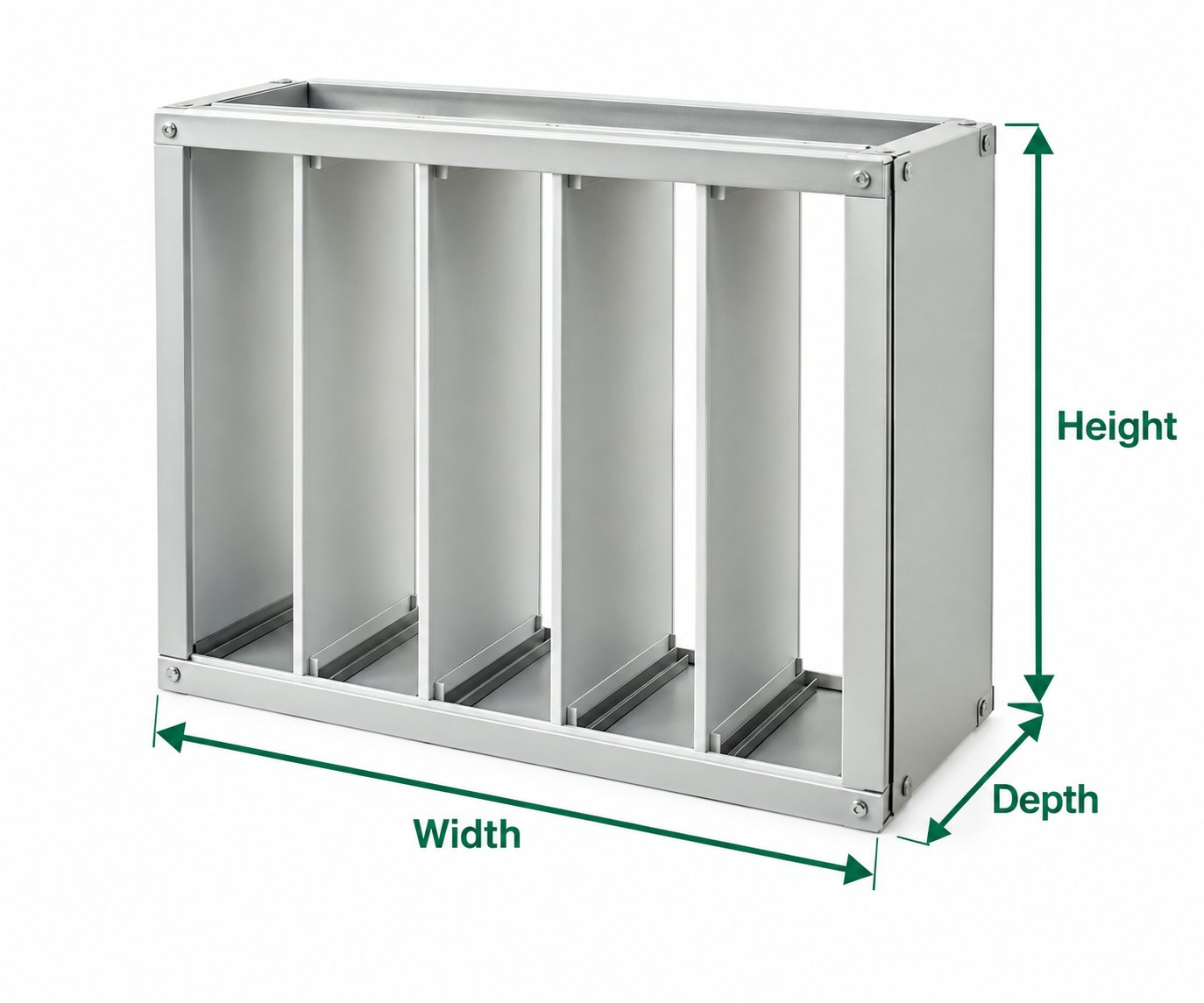
Measure the opening to the nearest 1/8 inch before rounding anything. For a 15x15x1, the opening should measure slightly more than 15 inches in both face directions and roughly 1 inch deep.
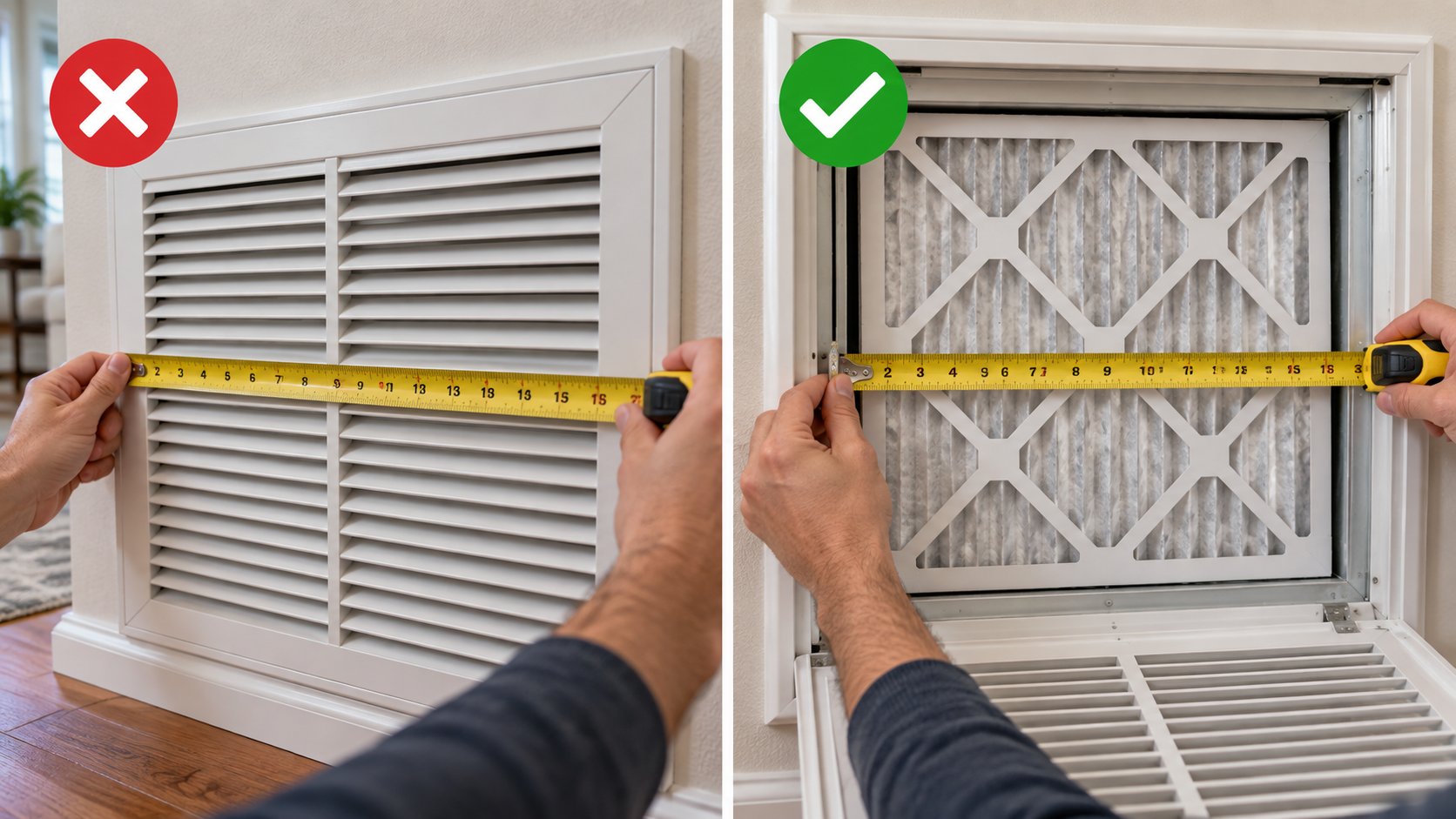
Width. Measure the inside of the track where the filter frame rests, not the outer grille face.
Height. Measure the track top to bottom, or front to back on a horizontal rack.
Depth. Measure the channel the frame slides into. About 1 inch means a 1-inch nominal filter; a deeper cabinet signals a 2-inch or 4-inch media filter instead.
What Is the Rounding Rule for Nominal Filter Sizes?
Nominal size is the rounded label; actual size is what the frame measures. Round an old frame up to the next whole inch to get its nominal filter size. For an empty opening, work the other way: the filter you buy must be slightly smaller than the opening.
Rounding is where I see most wrong orders start. A frame measuring 14.75 inches per side rounds up to 15x15x1. A frame measuring 15.75 inches rounds up to 16x16x1, though it is only three-quarters of an inch larger.
One manufacturer's 15x15x1 air filter product listing gives an actual size of 15.0 by 15.0 by 0.75 inches in MERV 8, 11, and 13, while 16x16x1 filters commonly list 15.75 inches per side. With the sizes that close, an opening near 16 inches calls for a 16x16x1, and an opening between roughly 15 1/8 and 15 1/2 inches is 15x15x1 territory. Actual sizes vary by brand; Resource 1 shows a full-size 15x15x1 specification.
Is It Really a 15x15x1? A 30-Second Check
Square test: Width and height should nearly match. A difference of an inch or more means a rectangular size.
Worked example: A rack of 15 3/8 x 15 3/8 x 1 inch plus an old frame of 14 3/4 x 14 3/4 inches both point to 15x15x1, and the full-size listing in Resource 1 would clear that rack.
Photo record: Snap the tape against the empty rack and save it for the next order.
How Do You Measure a Return Air Opening Versus a Furnace Slot?
Measure the rack that holds the filter, never the cover you can see.
Return grilles: Open the hinged face and measure the inner frame. The louvered cover is usually larger, which is how a 15x15x1 opening gets mistaken for a bigger size.
Furnace or air handler racks: Remove the filter door and measure the slide-in channel. Afterward, check that the door gasket closes fully.
Multiple returns: Measure each one; sizes can differ.
After a system swap, recheck the rack; see this guide on avoiding an undersized filter after an AC replacement.
How Do You Know the New Filter Fits Correctly?
The EPA's Guide to Air Cleaners in the Home says a filter should fit snugly so air does not leak around it, without bending or crushing. Run four quick checks:
Gap: I run a finger along all four edges; no rack edge or space should show.
Bow: The frame sits flat without rippling.
Door: The access door or grille latches without pressing on the filter.
Arrow: Airflow points toward the blower.
For a full walk-through, see this expert advice on properly installing an air filter.
What the Rack Taught Me About Unlabeled Filters
"I stopped trusting cardboard edges after measuring unlabeled filters that were off by a full size. Now the empty rack is the only number I rely on, and the 15x15x1 is where that habit matters most, because its listed actual size leaves almost no room for error."
Carlos Bardney, Author, ac-replacement.com
Essential Resources: 7 Trusted Guides for Choosing and Fitting a 15x15x1 Filter
Guides 1 to 4 cover fit; 5 to 7 cover filtration.
1. Confirm the Exact 15x15x1 Dimensions Before You Buy
The product listing gives an actual size of 15.0 x 15.0 x 0.75 inches in MERV 8, 11, and 13, the numbers to hold against your slot measurement.
Source: 15x15x1 filters with a listed actual size of 15 by 15 inches
2. Find Where Your Filter Lives and How Often to Change It
The American Lung Association explains that most central systems hold a 1-inch filter at the air handler or in a return grille, changed about every two months.
Source: Air Cleaning, American Lung Association
3. Learn Why Your Slot Is Probably 1 Inch Deep
The National Air Filtration Association describes the 1-inch depth built into most air handlers and hinged return grilles, and why that limits filter choices.
Source: Residential Air Filtration, National Air Filtration Association
4. Stop Air From Slipping Around a Loose Filter
The California Air Resources Board says a filter must fit tightly in its holder to prevent bypass, and it charts capture efficiency by MERV level.
Source: Air Cleaning Devices for the Home, California Air Resources Board
5. Get the EPA Basics on Home HVAC Filters
The U.S. EPA hub collects its guides on selecting and maintaining furnace and central air filters.
Source: Air Cleaners and Air Filters in the Home, U.S. EPA
6. Choose a MERV Level That Helps With Allergies
The American College of Allergy, Asthma and Immunology recommends disposable MERV 11 to 13 filters as the cost-efficient choice and warns that cheap fiberglass filters fall short.
Source: Air Filters, American College of Allergy, Asthma and Immunology
7. Make Sure Your System Can Handle a Higher MERV
ASHRAE notes that higher MERV filters add airflow restriction, so confirm your equipment's limit with the manufacturer before upgrading.
Source: Residential Filtration Technical FAQ, ASHRAE
Supporting Statistics: What the Research Says About Filter Fit and Airflow
These findings are why I treat filter size as a measurement, not a guess.
1. Poor Installation Can Add About 30% to Heating and Cooling Energy Use
NIST spent three years measuring common installation faults.
Incorrect indoor airflow ranked among the biggest causes.
A wrong-size filter is an airflow fault you can fix yourself.
Source: Energy Efficiency of HVAC Equipment Suffers Due to Poor Installation, NIST
2. A Clean Filter Can Cut AC Energy Use by 5% to 15%
The U.S. Department of Energy ties the savings to replacing a clogged filter.
Blocked airflow pushes dirt past the filter and onto the coil.
Source: Maintaining Your Air Conditioner, U.S. Department of Energy
3. Two-Thirds of U.S. Homes Cool With a Central System
88% of households use air conditioning, per EIA's 2020 survey.
Two-thirds rely on central AC or a central heat pump.
Both depend on a correctly sized return filter.
Source: Nearly 90% of U.S. Households Used Air Conditioning in 2020, EIA
Final Thought & Opinion
An unlabeled filter still has a clear answer:
Measure the opening.
Round old frames up.
Choose a filter slightly smaller than the slot.
Confirm it sits flat with no gaps.
My take: the nominal label is the real problem.
A name like 15x15x1 describes a category, not a part.
One maker cuts the 15x15x1 to a full 15 inches.
A typical 16x16x1 is only three-quarters of an inch larger.
Most common mistake I see: measuring the grille cover instead of the frame behind it.
Write the confirmed size on the rack so the next order takes seconds.
Next Steps
Before you buy:
Measure the opening to the nearest 1/8 inch.
Round the old frame up; 14.75 means 15.
Choose a size slightly under the opening, using the 15x15x1 listing in Resource 1 as your benchmark.
Pick MERV 8 for dust or MERV 11 to 13 for allergies, if your system allows.
After it arrives:
Install it with the arrow toward the blower.
Check every edge for gaps.
Label the rack and set a monthly filter check.
Frequently Asked Questions
How Do I Find My Air Filter Size If Nothing Is Printed on It?
Measure the opening to the nearest 1/8 inch, then round the old frame up. When both agree, you have your size.
Should I Round Up or Down When Measuring an Air Filter?
Round an old frame up. For an empty opening, choose a filter slightly smaller than the opening.
Is a 15x15x1 Filter Actually 15 by 15 Inches?
It depends on the maker. The listing in Resource 1 gives a full 15.0 by 15.0 by 0.75 inches, while other brands may cut it smaller, so check listed actual dimensions.
Can I Use a 16x16x1 Filter in a 15x15 Slot?
No. A 16x16x1 commonly measures 15.75 inches per side and will not sit flat in a 15-inch opening. Trimming or bending it creates bypass gaps.
What If My Measurements Match No Standard Size?
Order a custom-cut filter instead of trimming one, or have a technician check the rack.
Confirm Your 15x15x1 Before You Order
A tape measure and five minutes will tell you whether your unlabeled filter is truly a 15x15x1. Check your three measurements against the full-size 15x15x1 listing in Resource 1 before choosing the filter that sits flat and snug in your opening.
Glossary
Nominal size: The rounded dimensions printed on a filter, such as 15x15x1, used for ordering.
Actual size: The true measured dimensions of a filter frame, usually slightly smaller than nominal.
Filter rack: The track or frame in a furnace, air handler, or return grille that holds the filter.
Return air grille: The louvered cover over a return duct opening, often with the filter directly behind it.
Filter bypass: Air that flows around a loose or undersized filter instead of through its media.
MERV: Minimum Efficiency Reporting Value, the ASHRAE Standard 52.2 particle-capture rating; higher numbers capture smaller particles. See the EPA's MERV rating explainer and this air filter MERV ratings chart breakdown.
Learn more about HVAC Care from one of our HVAC solutions branches…
Filterbuy HVAC Solutions - Weston FL
2573 Mayfair Lane Weston FL 33327
(754) 296-3528
https://maps.app.goo.gl/E3tjmKf5VSWYghGc7